
Clarke County Arrest Records and Court Charges
An arrest record is the account of the arrest itself. It shows who was taken in, which agency made the arrest, and when booking happened. In Clarke County, the Sheriff runs the county jail and keeps the jail docket. Sheriff Anthony Chancelor serves as the county jailor, and his office logs each booking. The county does not post a live jail roster online. For the custody and booking side, including who is held now, the jail roster and booking detail sit on the Clarke County inmate records page. That page covers the sheriff, the jail, and how to confirm custody by phone.
The court charge record is a different file. An arrest does not set the charges. After a person is booked, a prosecutor reviews the facts and decides what to file. The charges filed with the court become the charge record, and the court clerk tracks them as the case moves. These court charges after arrest can shift over time. The full case file, with pleas, hearings, and the final outcome, lives in the Clarke County criminal court records. Arrest records and charge records work together, yet they answer different questions.
How to Find Clarke County Arrest Records
Clarke County does not run its own case-search website. Circuit and Chancery court cases are filed through Mississippi Electronic Courts, known as MEC. The public side is called PAMEC. You register, log in, pick the court district, and search by name or case number. Clarke County Circuit Court joined MEC on a set go-live date. Older charge records may not show up online, so the clerk counter is the fallback for those.
- Open the PAMEC public access portal and register for an account.
- Select the 10th Circuit Court District for Clarke County felony and major criminal cases.
- Search by the defendant's name or the case number, then open the case.
- Read the charge list and check each charge's code, level, and current status.
Charges also roll up into a person's criminal history. In Clarke County, requests for criminal history go to the Circuit Clerk. The county FAQ routes criminal history, civil litigation, and tax liens to that office. For someone in state prison after sentencing, the Mississippi Department of Corrections runs a separate search by name or ID. Each source shows a different slice of the same record. Note: Circuit Court records filed before the MEC go-live date may not appear online, so call the Circuit Clerk for older charge files.
Who Files Clarke County Charges
After a felony arrest in Clarke County, the case starts in Justice Court. Justice Court handles the initial appearance and the affidavit that opens a felony matter. Its judges hold court sessions at the jail three times each week. This keeps the initial appearance within three days of arrest. At this early stage, the formal charging document has not always been filed.
Two offices file charges for the state. The County Prosecuting Attorney, Edward N. Kramer III, handles felony matters before the justice or county court and can take matters to the grand jury. The District Attorney for the 10th Circuit District, Kassie Coleman, prosecutes felonies once they reach Circuit Court. Her district covers Clarke, Kemper, Lauderdale, and Wayne counties. One elected DA serves all four.
That shared office is described on the Wayne County district attorney page, which lists the same 10th District prosecutor.
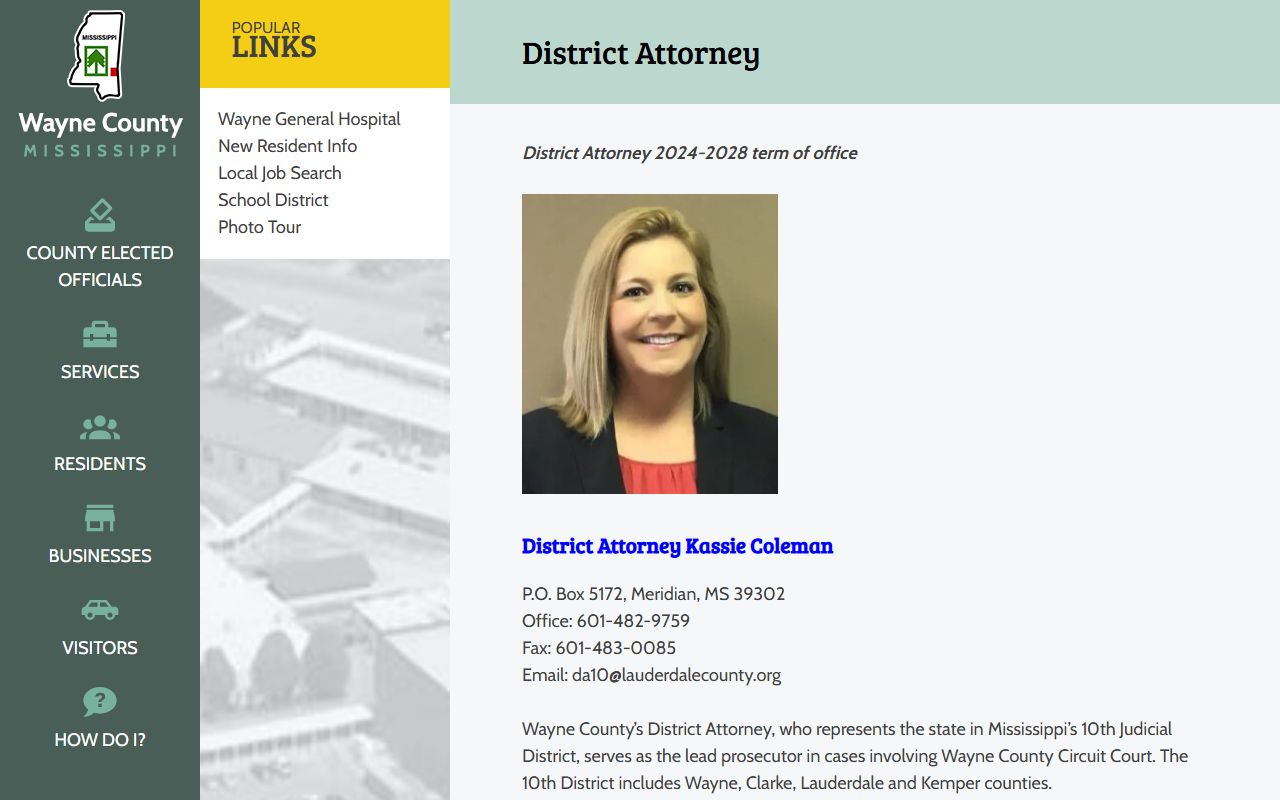
Because one prosecutor's office spans four counties, a Clarke County charge and a Wayne County charge may be handled by the same staff. The county court page also lists contact details for the prosecutors who file local charges.
How Clarke County Charges Get Filed
The charge record begins when a charging document is filed. There are three main types. A complaint or affidavit often starts a misdemeanor or a felony's first appearance. An information is filed by the prosecutor. An indictment comes from a grand jury and is common for serious felonies. In Clarke County, a felony charge is often filed by affidavit in Justice Court, bound over, and later indicted in Circuit Court.
| Complaint | Information | Indictment | |
|---|---|---|---|
| Filed By | Officer or prosecutor | Prosecutor | Grand jury |
| Common For | Misdemeanors, first appearance | Many felonies | Serious felonies |
| Where It Starts | Justice or Municipal Court | Circuit Court | Circuit Court |
| Grand Jury Needed | No | No | Yes |
Note: A felony arrest in Clarke County usually moves from a Justice Court affidavit to a grand jury indictment before the Circuit Court charge file is complete.
Clarke County Charge Codes and Levels
Each charge ties to a section of Mississippi law. The code points to the exact statute the person is accused of breaking. Charges also carry a severity level. A felony is the most serious class. A misdemeanor is a lesser offense. An infraction or ordinance violation is lower still. One arrest can lead to several separate charges, and each one carries its own code and level.
In Clarke County, lower-level matters often stay in Justice Court or Quitman Municipal Court. Felonies move to Circuit Court. The level of a charge shapes where the case is heard, what penalties apply, and whether a grand jury must act. When a charge is reduced, both its code and its level change in the record. Reading the code and the level together tells you how serious the charge really is.
Reading Clarke County Charge Status
Charges rarely stay fixed. As a case moves, a charge can be amended, reduced, added, dropped, or dismissed. Court records use status terms to track each change. Clarke County Circuit Court cases carry MEC status flags, so the same labels appear across the docket. Reading them tells you where a charge stands today.
| Status | What It Means |
|---|---|
| Pending | The charge is filed and the case is still open; flags like Arraignment Pending or Plea Pending may show. |
| Amended / Reduced | The prosecutor changed the charge, often to a lower level or a different statute. |
| Bound Over | A felony charge moved from Justice Court up to Circuit Court for further action. |
| Dismissed | The court ended the charge without a conviction. |
| Nolle Prosequi | The prosecutor formally chose not to pursue the charge. |
MEC flags such as Bound Over, Capias Pending, and Nolle Pros Pending appear on Clarke County Circuit Court records. A flag is a short status label, not the full story. Open the docket entries to see the order behind each one.
Clarke County Criminal History Lookups
A single case shows one set of charges. A criminal history shows charges across cases and years. In Clarke County, criminal history requests go to the Circuit Clerk. For state prison custody and sentencing, the Mississippi Department of Corrections runs a name or ID search. The Mississippi Department of Public Safety also keeps a public sex offender registry that lists Clarke County as a search option.
Some charges are federal, not local. Federal crimes in this area are prosecuted by the U.S. Attorney, and those cases never appear in county or MEC records. Charging and prosecution information for the region is published by the U.S. Attorney for the Southern District of Mississippi.
If a Clarke County matter is federal, the charge record is held by the federal court, not the county clerk. Most arrests in the county, though, lead to charges in Justice Court or Circuit Court close to home.
Charges vs. Convictions
A charge is an accusation. A conviction is the result. Being charged does not mean a person was found guilty. Many charges end in dismissal, reduction, or acquittal. The two carry a different legal weight and a different burden of proof.
| Charge | Conviction | |
|---|---|---|
| Stage | Accusation | Verdict or plea |
| Burden of Proof | Probable cause | Beyond a reasonable doubt |
| Means Guilt | No | Yes |
| Public Record | Yes | Yes |
Background Check Considerations
Public charge records and formal background checks are not the same thing. A casual lookup on a court portal shows what is public. A background check used for jobs, housing, or credit must follow the federal Fair Credit Reporting Act. Those reports come from regulated agencies, not from a free court search.
Federal charge questions go to federal prosecutors, while county charge questions go to the Clarke County clerks. Contact details for prosecutors in this district are listed on the U.S. Attorney's office contact page.
Knowing which office holds a charge saves time. County charges trace back to the Circuit Clerk or Justice Court, and federal charges trace back to the office shown above.
Important: This site is a private resource, not a consumer reporting agency under the FCRA, and its records cannot be used for employment, tenant, credit, or insurance decisions.
Sealed vs. Expunged Records
Not every charge stays public. A sealed record is hidden from ordinary public view but still exists. An expunged record is removed and treated as if it never happened. Mississippi allows expunction of some charges by petition, often when a case was dismissed, dropped, or ended in a not-guilty result.
| Sealed | Expunged | |
|---|---|---|
| Visibility | Hidden from the public | Treated as never existing |
| Law Enforcement | Limited access | Very limited access |
| Eligibility | Set by court order under state law | Petition under Miss. Code § 99-19-71 |
Expunction is not automatic. A person files a petition under Miss. Code Ann. § 99-19-71 in the court that handled the charge. Eligibility turns on the offense, the outcome, and any prior record. The Circuit Clerk or an attorney can confirm whether a Clarke County charge qualifies.
Restricted Charge Records in Clarke County
Some charge records are closed to the public. Youth Court charges that involve juveniles are confidential under Miss. Code Ann. § 43-21-251. Sealed and expunged charges drop out of public view. Charges tied to an open investigation or a sealed indictment may not show until an arrest or a court action. Adoption and mental commitment matters are restricted as well.
Mississippi's Public Records Act supports access to public government records. Even so, court files can be limited by sealing, expunction, youth-court rules, or a judge's order. When a record is not online, the clerk counter is the next step. A written records request to the office that holds the file is the formal route. Note: Confirm whether a charge record is sealed, expunged, or confidential before relying on a public search, since restricted files may not appear at all.